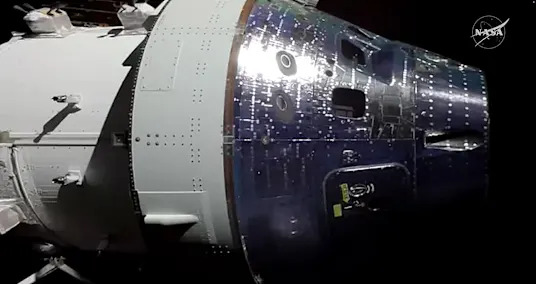
The Artemis II astronauts, on track for a flight around the dark side of the moon Monday, faced a relatively quiet day aboard their Orion crew capsule Saturday while engineers on the ground worked to solve a toilet issue.
Overnight, Artemis II commander Reid Wiseman, Victor Glover, Christina Koch and Canadian astronaut Jeremy Hansen reached a milestone of sorts on their historic voyage to the moon.
"And Integrity, (this is) Houston, we have some news to share with you," called spacecraft communicator Jackie Mahafey in mission control. "As of 30 seconds ago, you are now closer to the moon than you are to us on Earth."

"Wow, Jackie, thank you for sharing that with us," replied Koch. "We all kind of had a collective, I guess, expression of joy at that. It's hard to imagine, but we can see here on our (instrumentation) that we are at 118,000 nautical miles (from the moon). So yeah, you can do the math."

She said the crew was enjoying views of the moon through Orion's docking hatch window.
"It is a beautiful sight," Koch said. "We're seeing more and more of the far side, and it's just a thrill to be here."

The crew has had intermittent problems with their space toilet since launch on Wednesday, occasionally being told to avoid its use in favor of collapsible contingency urinals, or CCUs, bags used for urine collection that can be emptied to space later.
Early Saturday, as the crew was preparing for bed, flight controllers were unable to dump the toilet's stored urine overboard as needed, possibly because of a frozen vent line. The astronauts were told, once again, to use their CCUs until the problem was resolved.
Later in the day, after crew wakeup, flight controllers re-oriented the Orion capsule to allow sunlight to warm up the waste water vent line in hopes of thawing any frozen material. The procedure was referred to as a "bake out."

"We have increased the heater temperatures on the nozzle and the lines themselves, and we're hoping that if the problem is the freezing of the vent lines ... then this will give us a chance to see if we're able to solve that," mission control radioed the crew.
"We'll have the cameras on it and we'll be able to take pictures of that. Due to all of this, we've replanned overnight, your timeline is going to be a little bit in flux. We're working on pulling some things forward. Some things might have to move off of the morning because of this maneuver."
Veteran astronaut Don Pettit said in a social media post on X that a CCU is "essentially an open container (reusable, sealable and drainable) that controls the urine-air interface using capillary forces like my Space Cup does coffee," he said, referring to a cup he designed for drinking coffee in weightlessness.

"When you are in cislunar space with a broken toilet," he continued, "you need contingencies, and the CCU replaces the need for about 25 pounds of diapers."
Otherwise, Orion was performing well. For the second day in a row, a planned trajectory correction thruster firing was called off after analysis showed the spacecraft was still on a near-perfect trajectory.
Later Saturday, Wiseman and Glover planned to take a turn at manually piloting the Orion capsule to help engineers better understand how the spacecraft performs in flight and to provide hands-on feedback for future Artemis astronauts.
All four crew members were expected to spend time late in the day reviewing their plans for video and camera mapping of the lunar surface when they pass behind the moon on Monday. Close approach on the far side, at an altitude of about 4,100 miles, is expected at 7:03 p.m. EDT.
The moon has been observed in great detail by satellites at lower altitudes, but the Artemis II crew will have a unique chance to observe features on the lunar far side that no human has ever directly experienced.
White House reacts to F-15E fighter jet downed over Iran
LATEST POSTS
- 1
 Scientists dove hundreds of feet into the ocean and found creatures no human has ever seen. Our trash beat us there
 - 2The most effective method to Execute a Lung-Solid Eating routine After a Cellular breakdown in the lungs Finding
- 3Which Brilliant Home Gadget Can't You Reside Without?
- 4Instructions to Safeguard Your Speculations In the midst of Changing Disc Rates
- 5How Seniors Can Use Refunds and Motivators to Purchase a Hyundai Ioniq EV


- A Gustav Klimt painting is now the most expensive piece of modern art sold at auction. The fascinating history behind the $236 million 'Portrait of Elisabeth Lederer.'
- Moscow: Russia well-positioned to withstand oil market shocks
- 7 Moves toward a Sound and Dynamic Way of life
- Manual for Tracking down Spending plan Agreeable Travel Objections
- Taylor Momsen explains why she quit 'Gossip Girl': 'I really didn't want to be there'
- Artemis 2 moon rocket gets 'America 250' paint job | Space photo of the day for Dec. 23, 2025
- Scientists solve the mystery of 'impossible' merger of 'forbidden' black holes
- The most effective method to Offset Album Rates with Liquidity Needs
- Scientists document a death from a meat allergy tied to certain ticks