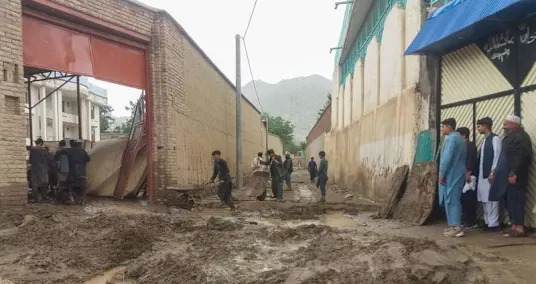
At least 61 people have been killed and 116 injured across Afghanistan since March 26 due to heavy rainfall, floods, landslides and lightning strikes, the Afghan government said on Saturday.
At least four people were still missing after floods affected thousands of families and damaged 2,448 houses, Afghan government spokesman Zabihullah Mujahid said in a post on X.
In addition, thousands of hectares of cropland was also destroyed, posing serious risks to rural communities who rely on agriculture for their livelihoods.
Deadly flooding has struck Afghanistan repeatedly in recent years, causing significant loss of life, injuries and widespread damage to homes, infrastructure and agricultural land.
Extreme weather events such as flash floods and droughts are increasing in Afghanistan, which experts link to the climate crisis.
Despite having a negligible carbon footprint, the country ranks among the most climate-affected nations and remains ill-prepared to cope after decades of conflict, poor infrastructure and a struggling economy, compounded by recent earthquakes and severe flooding.
LATEST POSTS
- 1
 Beating Wellbeing Difficulties: Individual Victories in Health
 - 2Seoul says sorry after unapproved drone flights into North Korea
- 3I'm a woman who's into weightlifting. Was I man enough for the creatine-packed 'Man Cereal'?
- 4Esteem Stuffed Gaming Workstations to Consider
- 5‘Serving is not just a place’: Bayside Church Granite Bay reimagines annual mission amid conflict in Mexico





- Manual for Financial plan Agreeable PC
- IDF says up to 90% of Iran’s weapons industry could be hit within days
- Remain Fit: Powerful Wellness and Work-out Schedules for a Better You
- New science points to 4 distinct types of autism
- High-Suggested Broilers For Your Homes
- From record warming to rusting rivers, 2025 Arctic Report Card shows a region transforming faster than expected
- Spotify Wrapped and Apple Music Replay are here: Top songs, albums and artists of 2025
- Grasping the Course of Evacuation and Extradition in U.S. Migration
- Scientists are getting our robotic explorers ready to help send humans to Mars