When you buy through links on our articles, Future and its syndication partners may earn a commission.

For the first time in more than 50 years, humans are cruising through lunar space.
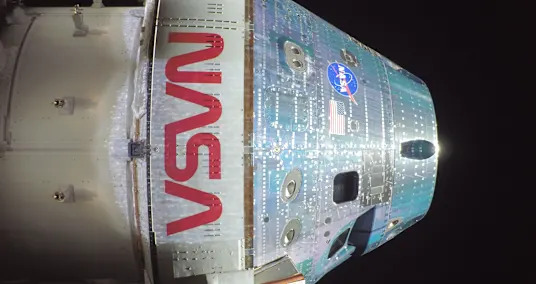
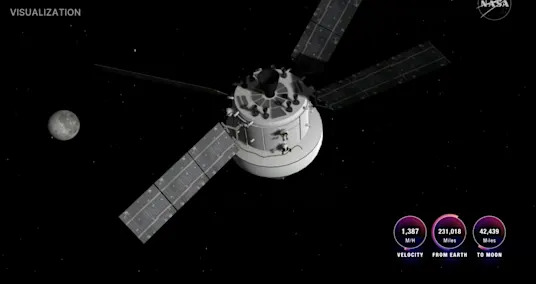
The four astronauts of NASA's Artemis 2 mission arrived in the moon's sphere of influence — the region where lunar gravity exerts a more powerful pull than that of Earth — today (April 6) at 12:37 a.m. EDT (0437 GMT).
The milestone occurred when the mission's Orion capsule was about 39,000 miles (62,764 kilometers) from the moon and roughly 232,000 miles (373,368 km) from Earth, a commentator said during NASA's Artemis 2 livestream.
The Artemis 2 astronauts — NASA's Reid Wiseman, Victor Glover and Christina Koch and the Canadian Space Agency's Jeremy Hansen — are the first people to cross the lunar threshold since December 1972, when the three-person Apollo 17 moon-landing mission did so.
Artemis 2 will not touch down on the moon, or even enter lunar orbit. Rather, Orion will loop around the moon's far side this evening in a history-making flyby. During that encounter, Artemis 2 will get farther from Earth than any crewed flight ever has.
The distance record is currently held by the Apollo 13 astronauts, who got 248,655 miles (400,171 km) from our planet in April 1970. At the height of tonight's flyby, just after 7 p.m. EDT (2300 GMT), Artemis 2 will be 252,757 miles (406,773 km) away from the rest of humanity, NASA officials have said.
The Artemis 2 astronauts will study the moon during the flyby, gathering data that could help scientists better understand the terrain and geology of Earth's nearest neighbor. They'll also be treated to a total solar eclipse, which will not be visible to those of us here on terra firma.
In addition, the flyby will chart their path home: Lunar gravity will slingshot Orion back toward Earth. Artemis 2 astronauts will come home on Friday (April 10), ending their 10-day mission with a parachute-aided splashdown off the coast of San Diego.
Editor's note: This story was updated at 1:15 a.m. EDT on April 6 with NASA's revised time of Orion's entry into the moon's sphere of influence — 12:37 a.m. EDT rather than 12:41 a.m. EDT.
LATEST POSTS
- 1
 Dozens of hidden star streams found in the outskirts of our Milky Way galaxy
 - 2Transform the daily grind to make life more interesting – a philosopher shares 3 strategies to help you attain the good life
- 3Smuggler who called migrants 'chickens' jailed
- 46 Modest and Strong Tire Brands
- 5Hypothermia claims newborn in Gaza and more babies are at risk, doctor says




- Merz: 80% of Syrians in Germany expected to return within three years
- The Reduced Portage Horse: An Inheritance Reconsidered for Present day Experience
- The beauty advent calendar boom is here. Sephora kids are all in.
- Tickets for 'Stranger Things' Season 5 finale, to be shown in movie theaters on New Year's Eve, go on sale today. Here's how you can save your seat.
- Tech Patterns: Contraptions That Will Shape What's in store
- The 1st full moon of 2026 rises tonight! Here's what to expect from January's supermoon Wolf Moon
- Artemis II live updates: NASA's moon mission breaks Apollo record for farthest distance humans have traveled from Earth
- Germany expresses 'great concern' over Israel's new death penalty law
- Most loved Seared Chicken: Which Chain Rules?